
If dentures are uncomfortable, one solution is a soft liner. A soft liner can be placed in new dentures, or when they are relined.
If you have worn dentures for a long time, the jaw bone will shrink, and the bony ridge on which they rest can become sharp and can be a source of sores. In some cases, it can be very difficult to get a comfortable denture. A soft liner is one solution for that. In addition to being gentler to the tissue, a soft liner can be fabricated to “grab” the ridge a little bit by engaging undercuts.
Characteristics of Soft Liners for Dentures
These soft liners are made from a special medical grade silicone-type compound. Placing them involves either one or two appointments, depending on the material used. The original soft liners had to be made in a dental laboratory. There are new materials, however, that can be mixed right in the dentist’s office and cured on the spot, meaning that the soft liner can be made in one appointment and you don’t have go for any period of time without your dentures.
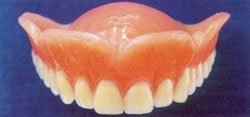
Picture of a soft liner in a denture,
courtesy of Eliason dental laboratory,
Portland, Maine
A certain thickness of the material is required for it to function properly, meaning that plastic has to be ground out from the inside of the denture to make room for the new liner. If there isn’t enough space for a soft liner, this creates a problem, possibly requiring the use of a reinforcing metal framework for the dentures.
Soft liners are slightly porous. This means that they will attract microorganisms, and it will be more important to keep them clean.
Advantages of Soft Liners
- They are more comfortable.
- They stay put better.
- You may be able to chew better, since they are more snug and more comfortable.
Disadvantages of Soft Liners
- They are more expensive than hard liners.
- They deteriorate more quickly and need to be replaced more often. Expect a soft liner to last a couple of years before needing to be replaced.
- They are more difficult for the dentist to adjust. It is hard to grind away the material if you do have a sore spot. Compensating for this difficulty, you are less likely to need an adjustment.
- Cleaning them is more important and a little more difficult.
- Repair of the dentures also becomes more complicated.