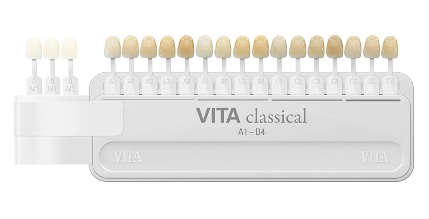
Dr. Hall,
I’m getting ready to get my veneers would BL4 be too white or would it be natural looking? Thank you!
Wayfon from North Carolina
(See Dr. Hall’s answer below.)
We thank our advertisers who help fund this site.
Wayfon,
For the benefit of our readers, the BL shades were developed by Ivoclar some years ago after tooth bleaching became popular, and they are whiter than teeth are found naturally. BL1 is the whitest, and BL4 is only slightly whiter than the whitest natural shade.
When I did a smile makeover for one of my patients, I had a little questionnaire I gave them where I asked them questions about how they wanted their new smile to look. One of those questions was about the color they wanted. I asked them to rate, on a scale of 1 to 10, whether they wanted a white color or a natural color. Marking a “1” indicated that they wanted bright white teeth. Marking a “10” indicated that they wanted a more subdued color that didn’t stand out and made it look like there was nothing artificial.
You sound to me like, had you been my patient, you would have marked something between a “4” and a “6”—you want it as white as you can go with keeping it still looking natural. With you feeling that way, I would have recommended, as your cosmetic dentist, a shade B1 on the classic shade guide. With a “7” or “8,” I would have suggested an A1 shade. With a “9” or “10,” I may have gone to maybe halfway between an A1 and an A2. While my patients generally ended up very satisfied, over the long term, with the color we had helped them choose, I did have one smile makeover patient in the early days of my practice who chose the A2 shade and then later told me that she regretted not getting something whiter.
To help you see this, I have an image here 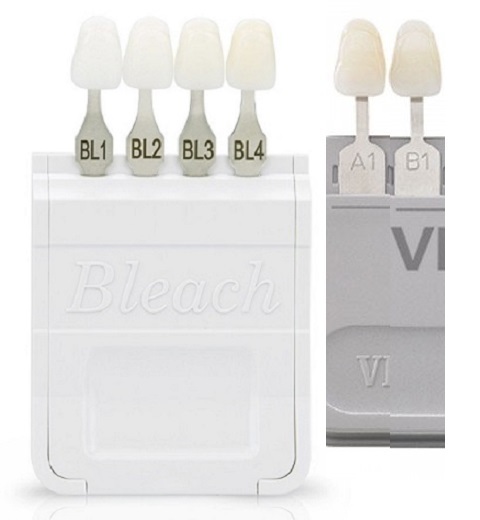 of the Ivoclar bleach shade guide with shade tabs for A1 and B1 on the classic shade guide pasted next to it, for comparison. A1 is typically the whitest we would see in patients, but there would be some with very white teeth who would have shade B1 naturally. B1 is a common shade of baby teeth but not very common in adult teeth. While keeping in mind that the photographs of these shade guides may have been taken under different lighting conditions, it is still apparent that the BL4 is noticeably whiter than the B1. So if you truly want your smile to look bright but natural, I wouldn’t go whiter than B1. With BL4 you will have lovely white teeth, but they may look somewhat whiter than natural and it may look to people like you have had work done on your teeth to make them that white. Having said that, I had some patients who really wanted bright white teeth that would almost light up a room. We would give them BL1, which we nicknamed “ballistic white,” (some offices call that “Hollywood white”) and they were very happy with them. It all depends on your personality. You have to decide what kind of impression you want to make with people. If you want your bright smile to be noticeable, I would go with the whiter look. If you want them looking lovely but not advertise that you have had work done, I would stick with B1.
I hope that’s helpful.
– Dr. Hall
Do you have a comment or anything else to add? We’d love to hear from you. Enter your comment below. Or click here to ask Dr. Hall a question.

About David A. Hall
Dr. David A. Hall was one of the first 40 accredited cosmetic dentists in the world. He practiced cosmetic dentistry in Iowa, and in 1990 earned his accreditation with the American Academy of Cosmetic Dentistry. He is now president of Infinity Dental Web, a company in Mesa, Arizona that does advanced internet marketing for dentists.
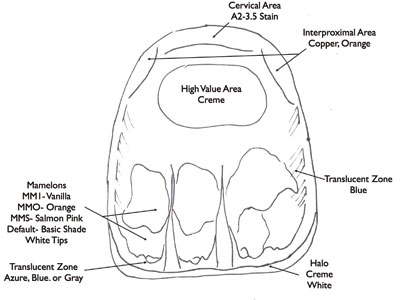 Here is a color map that is typical of what I would draw out for the ceramist when I did a single crown on a front tooth. In the written instructions, I would specify a basic shade. Let’s assume that is A2 for this tooth. Then, besides the basic shade guide, I had a set of tint tabs with various tints of pink, yellow, blue, etc. I would then draw areas where the ceramist would need to add any of those tints to get an exact match with the natural tooth. And then, like I said, after the crown came back from the ceramist I would do an initial try-in, see what the color discrepancies were, and write about those. Later, with the convenience of digital photographs, I would just snap a photo of the try-in and the ceramist could then see where the color needed to be adjusted to get a perfect match. I wouldn’t even THINK of cementing the crown until we had a successful try-in, which is one of the things that really bugs me about your dentist—that she would cement a crown when you didn’t like the color. In fact, my appointments for front tooth crowns were always scheduled as a try-in, and not until we had a successful try-in would we actually cement it.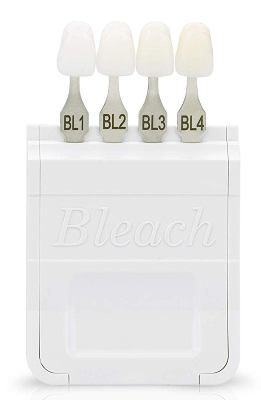
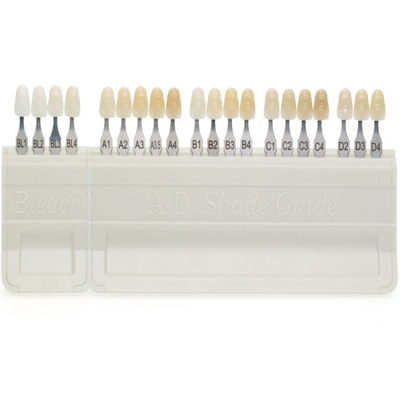
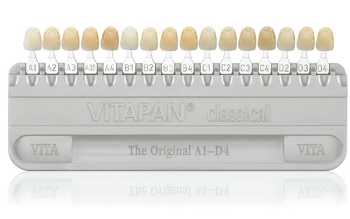
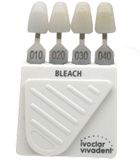 when teeth bleaching became popular, we started to have a problem with this shade guide. We would have people who needed porcelain crowns, and when we tried to find a shade that matched them, they would be “off the chart.” Their teeth would be much whiter than the whitest natural shade on the shade guide. In response, shade guide manufacturers developed new whiter shades. Ivoclar was the first manufacturer that I remember doing this, and our office purchased this four-shade guide and used it to communicate with dental laboratories. You can see that shade guide at the right.