
A tooth extraction, as a rule, is the most traumatic dental appointment there is.
As a dentist, I had many patients who were afraid of root canal treatments. But extractions were harder by far on the patient. It was paradoxical how some patients got into an extreme anxiety cycle with their teeth. They would be afraid of getting fillings, afraid of a root canal, and so would put off any care until they got a toothache that was so bad they had to come in. Then the only treatment they would accept was an extraction, which was the most traumatic treatment in my office. That would reinforce their perception that dental care was something they simply couldn’t endure, and they would stay away until the next toothache.
Many patients like to have conscious sedation for extraction appointments. Whether or not this is recommended depends on the patient. If you have no anxiety about the appointment at all, this isn’t necessary.
If you’re worried about the appointment, my advice is to have some sedative medication. This can be nitrous oxide gas, which is the most convenient, since you can drive yourself home right afterward. Or you can have a sedative pill, such as Triazolam or Valium, in which case you’ll need to have an escort after the appointment.
Post-operative Care for a Tooth Extraction
While you are still in the dental office:
- Sit still for a few minutes immediately after the appointment. You want to be sure that a blood clot has formed before you get up and move around, because you could provoke bleeding. The amount of time you need to sit still varies with the complexity of the extraction. If this was a baby tooth that was close to coming out on its own, you may only need one or two minutes of sitting still. For the simple removal of an adult tooth, you may need to sit for about ten minutes. For a surgical extraction in which stitches were necessary, it could be half an hour or longer. This amount of time could be longer if you tend to bleed longer than most people.
- You will be biting on a gauze while you are waiting. This keeps pressure on the site and assists in stopping the bleeding.
Advice on what to do after you leave the dental office:
- After you leave the office, you should be somewhat still, without strenuous activity, for about two hours. Don’t suck or spit, as this will inhibit the formation of a blood clot.
- Some persistent bleeding is normal. Expect your saliva to be tinged with blood for several hours.
- However, if you notice thick bleeding with dark red blood clots, you need to apply more pressure to the site. Most dental offices give you a pack of gauze in case this occurs. If you don’t have gauze, use a paper towel. Wad it up so that it’s small enough to fit in your mouth over the extraction site, so it puts pressure directly on the site, and bite on it for a good forty-five minutes. If the bleeding still hasn’t stopped, repeat this. If it still doesn’t stop, call the dentist or go to the hospital emergency room.
- For pain, after a simple extraction, you should be able to just take Tylenol or ibuprofen, or another over-the-counter pain remedy.
Surgical Tooth Extraction
When the tooth extraction requires an incision and raising a flap of tissue to get access to the tooth, it is called surgical. This is the case with most wisdom teeth. Here’s advice on what to do after a surgical tooth extraction:
- You should follow the above three instructions on bleeding.
- For pain medication, you’ve probably been given a prescription pain reliever. This prescription should be taken as needed for pain. There isn’t a strict prescribed schedule, but you should take the medication according to your individual needs.
- There will be swelling afterward. The more extensive the surgery that was required to remove the tooth, the more swelling there will be. Swelling occurs the first day and then usually peaks the second day. If you continue to swell beyond the second day, you should contact the dentist—you may have an infection. You can minimize the swelling in two ways: with ice packs applied to your face near the surgery for the first two days, and then by keeping your head elevated at night. Use an extra pillow. A raised head keeps fluids from accumulating in the head area.
- Keep the area of the surgery as clean as you can. The gentlest rinse you can use when you’ve had a surgical incision is warm salt water. You mix about half a teaspoon of salt in an eight-ounce cup of water, and then swish with that. Starting the day after surgery, you can brush the teeth next to the extraction site. Do this gently, however, because there is a risk of tearing the tissue that has just been sutured. Stay on your teeth only—don’t brush your gums as you may be used to doing. But cleanliness is very important. Food particles promote the growth of bacteria, which cause infections. You need to get rid of these food particles for proper healing. If it was wisdom teeth that were removed, it’s going to be hard to keep the area clean, but it’s going to be extra important, because those surgical sites are some of the most prone to getting infected.
- Eat only soft things the day of the surgery—fluids, milk, ice cream, puddings, etc. Starting the second day, you can start trying to eat other foods only if you feel up to it. The best advice here is to listen to your body and not push yourself to eat things you don’t have the strength to chew.
- You will have pain and it may be hard to open your mouth very far. This is normal. Your pain should lessen and your ability to open your mouth should improve some each day. If these things don’t get better, it could signal an infection and you should call your dentist.
A Dental Bridge after a Tooth Extraction
A missing tooth, unless it is a wisdom tooth, should be replaced. The ideal replacement is with a dental implant. However, a dental bridge can also work well. Here is a sample of a replacement done by Dr. David Hall, the author of this web site. It illustrates an esthetic and fully natural way to accomplish this.
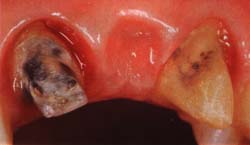
Here is a photograph of teeth prepared for bridgework, with the sculpted ovate pontic site.
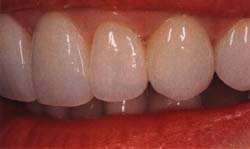
Here are the same teeth, with the bridge in place. This type of bridgework creates the illusion that the tooth is growing out of the gum. Work performed by Dr. Hall.
For more information on implants and bridges and why they are important, please see the page on missing teeth.
Other related information:
- If a molar is broken at the gumline, it doesn’t necessarily have to be extracted.
- Dental questions answered.
- One possible complication of wisdom tooth removal is a dry socket.
- Kathi from North Carolina has persistent pain in a tooth after a root canal procedure. Dr. Hall urges her to get a second opinion from another root canal specialist who cares more deeply, and cites an example of a tooth that was needlessly extracted upon the recommendation of a root canal specialist. Read this discussion about pain after root canal treatment.
- If you are having all your teeth extracted, you may wish to consider getting immediate dentures, which are placed in your mouth the same day as the surgery, so you don’t have to go weeks without any teeth.
Read Dr. Hall’s blog posts about extractions, where he answers questions from patients.
This content was written by Dr. David Hall. Click here to ask Dr. Hall a question.