
How do you minimize tooth decay or dental caries? A popular misconception is that if you get a lot of decay it means you’re not brushing well enough. While that is partially true, there are other factors that are more important. The subject is a lot more complicated than that.
To understand this subject, you need to first understand where tooth decay occurs. There are three principal places: on the smooth surfaces of the teeth, between the teeth, and in the pits on the chewing surfaces of the teeth. Of these three types, only smooth surface is significantly  affected by toothbrushing. Most people brush their teeth adequately, and so few people have problems with smooth surface decay.
Let’s illustrate this with some pictures:
First, here we show the smooth surfaces of the teeth. These places are cleaned by toothbrushing, and few people have problems with tooth decay here.
This second diagram shows the interproximal areas (between the teeth). 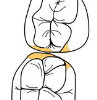 These areas can’t be reached by a toothbrush but can be reached by dental floss. A lot of tooth decay occurs here. You could brush twenty times a day and that will have no effect on tooth decay in these interproximal areas.
This third diagram shows the pits of the chewing surfaces of the back teeth. These pits are created by deep grooves that occur naturally as your tooth is formed after birth. Pits attract microscopic food particles and bacteria and are very prone to cavities. It isn’t possible for toothbrushing to clean out the pits of the teeth. Flossing doesn’t clean these areas either. The best preventive for pit decay is the placing of dental sealants, which closes off the pits to bacteria.
There is something else about the nature of tooth decay that few people understand that helps in understanding its prevention. Many people don’t realize that your body has natural defenses against cavities. Bacteria in plaque (the sticky film that adheres to your teeth) take the food you eat and convert it to acids that attack the surface of your teeth. You may notice that after certain foods, particularly sweet foods, you can have a sour aftertaste in your mouth. The acid that is being produced by the bacteria tastes sour. This acid works on the susceptible parts of your teeth to cause dental caries. However, your saliva has minerals in it that your body uses to repair the spots attacked by the plaque acid. It is only when the rate of attack exceeds the rate of repair that you actually get tooth decay. These minerals can deposit on your teeth as tartar, and that is the main reason you need periodic professional teeth cleanings. But the minerals perform a very useful function in repairing tiny spots of incipient decay.
So, how can you prevent cavities?
1. Brushing helps prevent smooth surface tooth decay. If you remove the plaque from smooth surfaces right after eating, it halts the acid attack.
2. Flossing similarly helps prevent cavities between the teeth.
3. Fluoride strengthens the teeth to better resist smooth surface tooth decay and also between the teeth and it increases the repair rate.
4. Pit and fissure sealants are very effective at preventing decay in the pits of the teeth.
5. Anything that helps stimulate saliva flow also helps combat cavities. Since saliva has the repair agents, more saliva means better repair. Also, saliva helps dilute the acids that attack your teeth and helps wash away the food particles before the bacteria can digest them. Surprising to some people is that chewing gum is good for your teeth. It helps clean your teeth and fight decay. Part of its preventive action comes from the saliva flow it stimulates. Even sugared gum, if you chew it past when the taste is gone, is healthy for your teeth.
6. But the most powerful weapon you have to limit decay is to limit the frequency of eating. It is not possible to clean the teeth fast enough and frequently enough and thoroughly enough to totally overcome every acid attack you have after every bite of food. The key is to give your natural mouth chemistry time to repair your teeth after an attack. If you limit yourself to your three meals and maybe a couple of snacks during the day and practice basic oral hygiene you can pretty well eliminate most dental caries.
There is also a misconception about the kinds of foods that cause decay. Yes, sweets cause decay, but any carbohydrates promote it – especially any that stick to your teeth, such as crackers or pretzels. Raisins cause food particles to stick in the pits of your teeth and will cause decay. Of candies, caramels are the worst because they stick. Also, hard candies that you suck for a long time are very bad. Chocolate actually has a decay inhibitor, as does anything with peanuts in it or cheese. Sugared drinks aren’t too bad, either, because they wash through the mouth rather quickly. But if you sip them all day they’re terrible because your saliva doesn’t have time between sips to do any repairs. Any sweets that you eat during a meal have practically no effect on tooth decay because they’re all part of one acid attack that hopefully your body will have time to fully repair before the next snack or meal.
Some people have been told that they have soft teeth. For my response to this, see our page about soft teeth. You probably don’t really have soft teeth but just have a habit of frequent eating.
Dr. Hall also answers a mother who writes that her daughter has an acid reflux problem, and wonders if this is why she gets so many cavities.
If you have braces, the braces collect food particles and you become particularly susceptible to dental caries around the braces. Even if you don’t get a full-fledged cavity, the first steps of the tooth decay process creates white spots around the braces. When the braces are taken off, these spots will be ugly and will need to be repaired by a cosmetic dentist. To avoid this, clean especially well, after every time you eat or snack, while you have braces.
Read what Dr. Hall has to say about electric toothbrushes.
Read about the loss of enamel from bulimia.
A lot of people ask about whitening toothpaste, as almost every manufacturer these days has whitening claims. Learn the straight scoop here.
Read what Dr. Hall says in his blog posts about tooth decay, where he answers questions from visitors. There is one question about the DIAGNOdent laser that is used to detect incipient tooth decay.
This content was written by Dr. David Hall. Click here to ask Dr. Hall a question.