
Dr. Hall,
My dentist says he can’t use an ovate pontic for my dental bridge because the ridge of gum is healed, and this technique is only used when there is a freshly extracted tooth. Is that true? Is there another technique that can make my tooth look like it is growing out of the gum so it is more natural?
—Brenda from Florida
Brenda,
The ovate pontic technique is primarily used when the ridge is fully healed, as in your situation. But it is common, when you present a technique to your dentist that he or she isn’t too familiar with, for the dentist to deflect your request by saying that it won’t work in your situation. I hear this all the time.
The photographs below show the ovate pontic technique. In the “before” photo, the tooth had been missing for years, and the ridge was fully healed. The gum tissue was surgically sculpted to prepare it for receiving the false tooth.
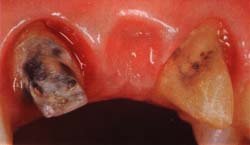
Here is a photograph of teeth prepared for bridgework, with the sculpted ovate pontic site.
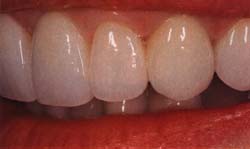
Here are the same teeth, with the bridge in place. The tooth in the middle, the lateral incisor, is a false tooth and is an ovate pontic. This work was performed by Dr. Hall.
Your approach here is a common mistake people make. It is easy to think you can research a technique on the Internet and then tell your dentist about it and get him or her to use this technique. But this doesn’t work—there’s a steep learning curve for most of these techniques, and there has to be a passion for appearance-related issues that the dentist feels. These cosmetic dentistry techniques aren’t hidden. Your dentist has probably heard about this technique but hasn’t taken the trouble to become familiar with it enough to use it.
A dentist who really knows how to do the ovate pontic technique will want to use it for most anterior bridge cases. Only when the bone has shrunk drastically can this technique not be used. And even then, there are “ridge-plumping” techniques that can build up the ridge, if appearance is important enough to the patient.
—Dr. David Hall
Click here to ask Dr. Hall a question.
History of the Ovate Pontic Technique
This ovate pontic technique was developed by Dr. David Garber, a prominent periodontist who practices with renowned cosmetic dentist Dr. Ronald Goldstein in Atlanta, Georgia. I first heard him lecture about it at an annual scientific session of the American Academy of Cosmetic Dentistry. The technique he presented involved sculpting the ridge in the position of the missing tooth so that it was concave and could receive the ovate pontic. Then he fashioned a temporary bridge to allow the gum to heal in this concave configuration and only when it was healed would he take the impression for the permanent bridge. The laboratory technician would then fabricate the bridge to fit the sculpted ridge. To me, this seemed excessively laborious, meaning that I would have to charge an excessive fee to the patient. My technique was to not sculpt the gum ridge until I actually had the bridge made. I would sculpt the model that the laboratory made from the impression I took, the laboratory would then make the pontic to fit that sculpted ridge, and then I would sculpt the actual gum ridge with an electrosurgery instrument when I placed the bridge. I removed enough gum tissue so that there was slight gentle pressure on the gum when I seated the bridge. I then temporaryily cemented the bridge to make sure the gum would heal properly and in the correct shape. After learning that the healing was very predictable, I would permanently cement the bridge on the spot to the freshly sculpted ridge and never had any problems with this technique.
Click here for referral to an expert cosmetic dentist.
Click here to go back to the frequent questions about cosmetic dentistry page.