
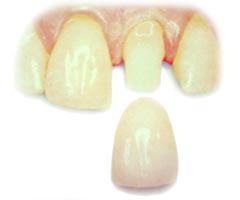
Back before the days of bonding technology, dental crowns nearly always needed to be made either entirely out of metal or with a metal foundation. Today, we can make them out of pure porcelain or other ceramics. There are still occasions on the back teeth when the durability of a metal foundation in the crown makes it the restoration of choice. But when it shows prominently in your smile, wouldn’t you rather have one that looks as natural as possible? See the photos at the bottom of the page that show the beauty of pure porcelain.
Why Porcelain Crowns Are Needed
It is needed when a tooth is badly broken down—there are existing large fillings or a large area of tooth decay, because a filling isn’t strong enough. And in the front of the mouth, you will want a porcelain crown that looks exactly like a tooth. If done by an expert cosmetic dentist, it will be very difficult for people to tell that it isn’t real. For information on locating an expert cosmetic dentist in your area, please see our cosmetic dentist referral page.
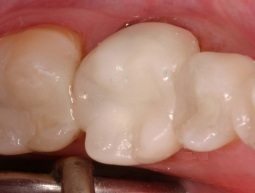 Before 1990, a pure porcelain crown on a back tooth would almost certainly break under chewing pressure. But bonding technology developed since then has allowed dentists to bond these ceramic crowns directly to the teeth. With this strong bond, it becomes strong enough to function under even moderately heavy chewing pressures. The photo to the left shows one that is functioning even under the stresses of a molar tooth.
Variations on Porcelain Crowns
The CEREC crown is made entirely out of ceramic. Porcelain is a type of ceramic, but porcelain isn’t as strong as the ceramic used in CEREC crowns. CEREC, rather than being made by a laboratory technician, is milled by a computer in the dentist’s office. Since they have some esthetic limitations in the hands of all but the most artistic of dentists, we would recommend them for back teeth, not front ones.
Empress crowns are also a variation similar to porcelain which uses the Empress pressed ceramic material. Other ceramic materials are Procera, In-Ceram, zirconia, and feldspathic porcelain.
e.max crowns are another variation. They are not truly porcelain but are a ceramic called lithium disilicate. It is pressed rather than fired, similar to Empress, but is much stronger. The lithium disilicate core is then veneered with porcelain for maximum aesthetics.
Zirconia crowns represent another even stronger ceramic. Where porcelain is risky to place on a second molar or in a patient with a particularly heavy bite, zirconia, which is also called ceramic steel, can be used confidently in these situations. It is strong enough to be used in a bridge, where a false tooth is suspended between two crowns. The use of zirconia has allowed some dentists to do completely metal-free dentistry.
Cost of Porcelain Crowns
A beautiful porcelain crown may have a cost that exceeds your dental insurance plan allotment. If your interests are purely functional—you don’t care how it looks—then you may not want to spend the extra money.
Dentists need special training in cosmetic dentistry in order to place these restorations. If you would like referral to a competent cosmetic dentist who is trained to do this type of work, check the menu above. Either go to “Find a Cosmetic Dentist” for referral to someone Dr. Hall has screened already, or go to “Ask Dr. Hall for a referral.”
A good cosmetic dentist will be familiar with all of these materials and will use the best crown for each clinical situation. They all have their advantages and disadvantages. I recommend strongly against urging a dentist to use a material or technique that he or she doesn’t recommend. Doing so will likely push the dentist out of his or her comfort zone and result in problems.
On back teeth, many cosmetic dentists do what are called porcelain onlays. These are very similar to all crowns, and sometimes the terms are used interchangeably. Using the term onlay, however, means that we are grinding away less of the tooth—we leave the healthy tooth structure alone as much as possible. With an onlay, since we can keep the margins away from the gum, we greatly reduce the tendency to gum inflammation that can occur with dental crowns. It also is metal-free. However, under very heavy biting pressures on the teeth furthest back, there is a cracking risk with a porcelain onlay. These onlays can also be made out of CEREC or other high-strength ceramics, greatly reducing the cracking risk.
Porcelain fused to metal crowns have a nearly natural appearance, subject to two limitations: Because they have a metal framework underneath, they require the use of an opaquer to cover the metal, which makes it impossible to fully re-create the translucency of natural teeth. They also eventually will show a dark line at the edge, next to the gum. This comes because the metal shows through at the margin. The dental lab often will cut back the metal at the margin to help this look better, but this technique never seems to completely eliminate the color discrepancy and the line that shows up. Dentists try to hide this line under the gum, but sometimes they are unable to do this; and sometimes the line doesn’t show when the crown is first placed but shows later, as the gum recedes. They can also create a porcelain butt margin that tends to minimize this dark line, but it doesn’t eliminate it. However, these crowns are stronger than all porcelain.
Below is a comparison of the appearance of porcelain fused to metal with bonded all-ceramic. Notice the picture on the left: Jo has several crowns across the front. I can pick out immediately the teeth that have crowns on them, probably even from across the room. How? Because they are opaque and have a dark line near the gumline. Contrast this with the after picture of Jo’s teeth on the right, which shows beautiful bonded all-ceramic work. This work was done by Dr. Craig Carlson, a www.mynewsmile.com cosmetic dentist from San Antonio, Texas. See how natural they look. For contact information for Dr. Carlson, click here.
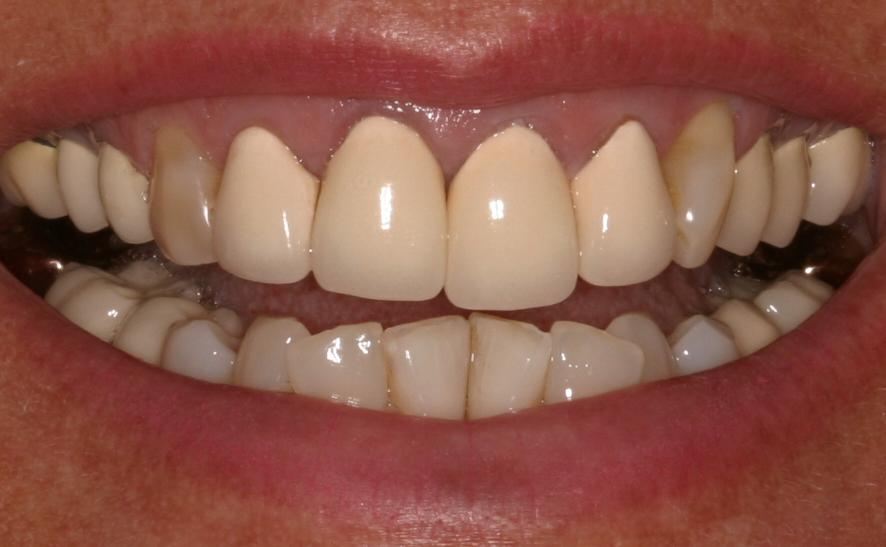
Before
Click image to see a larger photo.
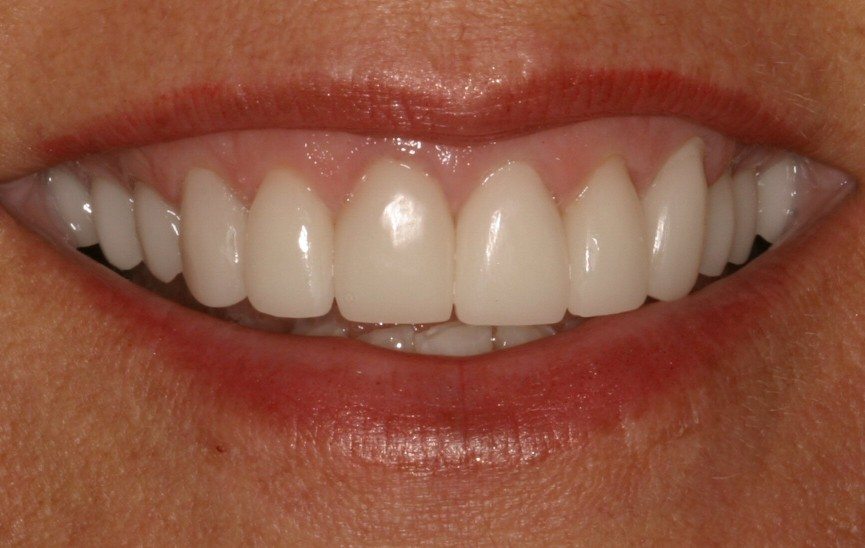
After
Click image to see a larger photo.
The Beauty of All Porcelain Crowns
Here is another example on a patient of mynewsmile.com network dentist Dr. Duane Delaune of Metairie, Louisiana. This patient had a mal-formed lateral incisor that made her self-conscious. Notice the beauty of the crown in the after picture that blends so perfectly with her natural teeth. You have to view the larger version of this case to fully appreciate it:
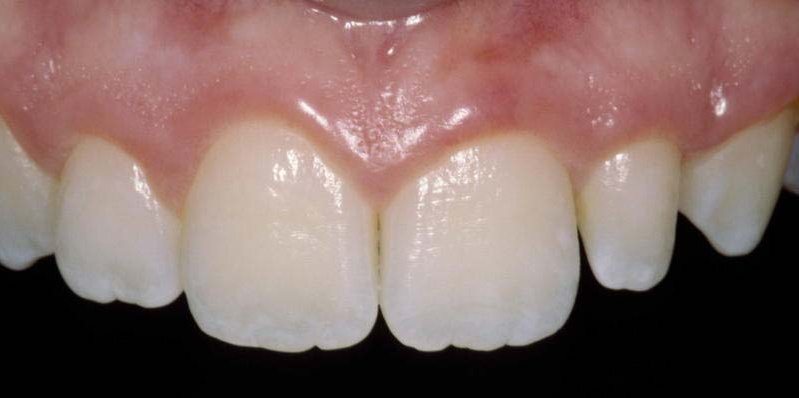
Before
Click image to see a larger photo.
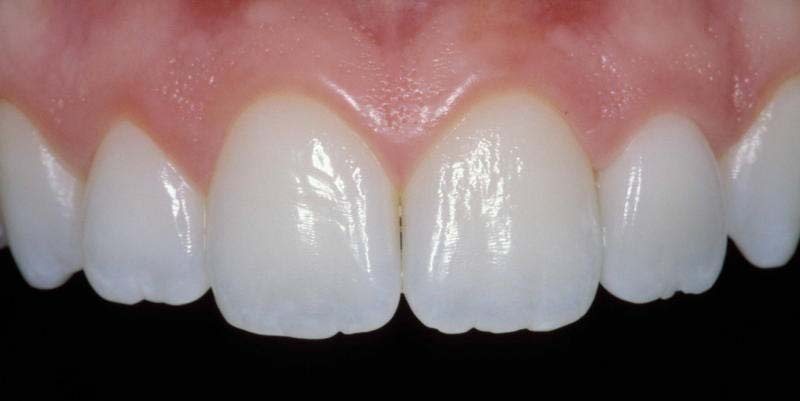
After
Click image to see a larger photo.
Read about dental bridges, and about the ovate pontic technique for creating the illusion that the false tooth is growing out of the gum.
You may also want to read Dr. Hall’s blog posts about porcelain crowns, where he answers questions from visitors.
By Dr. David Hall