
Composite tooth bonding is a cosmetic dentistry technique that can do beautiful things for your smile. Dental composite is made of particles such as silicon dioxide or quartz, bound with a tough synthetic resin. It is blended so that it comes in different shades, toughness, and translucencies and so that, with the proper artistic eye on the part of the dentist, it can match your teeth. It is then used to close tooth gaps, fill cavities, or eliminate spots, chips, and discolorations. It’s also great for an instant repair of a broken front tooth.
For an explanation of how teeth bonding could help your smile, please see our dental bonding page. We also have a page of photographs of tooth bonding work.
HOW IS COSMETIC TEETH BONDING DONE?
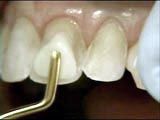 Unlike porcelain veneers, which are made of porcelain that has to be baked in an oven by a dental laboratory, teeth bonding is applied directly to the tooth and cured to its final hardness, usually with a light. In order to help the composite bond to the tooth, the tooth is prepared by lightly roughening the area to be repaired, which usually doesn’t require an anesthetic. Then the surface of the tooth is etched, which creates a microscopic roughness that allows a bonding resin to lock onto the surface. Then the thin, clear bonding agent is applied, and the composite is applied over that. Dental composites are made of acrylic resins impregnated with inorganic fillers, as mentioned above. They are made to a paste-like consistency so that they can be sculpted to the proper shape. They contain different pigments that can be matched to your tooth color, and they also come in varying degrees of translucency. Some are made to be high-strength, and they are often used for the bulk of the restoration. Other composites are made so that they can be polished to a high gloss. Often they aren’t as strong, so they are reserved for the outer surface of the restoration. Also, several layers of different shades and translucencies often need to be used in order to duplicate the depth of color and the color gradations that occur in natural teeth. All these composites contain photoinitiators so that they will harden under a high-intensity curing light.
With careful artistry, composite can be used to faithfully mimic the color details and translucency of your tooth and be polished to a beautiful shine. But a strong caution is in order here for the dental patient: While any general dentist can legally announce that he or she is a “cosmetic dentist,” and many dentists do white fillings, we recommend that any patient who wants cosmetic teeth bonding only go to a dentist with a strong artistic inclination and extensive post-graduate training in cosmetic dentistry. The teeth bonding techniques required to do composite bonding well are not required training by general dentists. And very few dentists have the artistic inclination needed. If you need help finding a cosmetic dentist with adequate training to be able to perform teeth bonding properly, please see our referral page. We list cosmetic dentists from all over the United States and Canada who have that additional training in cosmetic dentistry.
HOW LONG WILL THE TOOTH BONDING LAST?
The technology of composite tooth bonding materials is wonderful as far as the beauty that it can bring to your teeth. Still, with all that has been done, there are some limitations as to how long it lasts. It is susceptible to staining and loss of gloss. This deterioration doesn’t seem to be too noticeable if it is used in limited areas. But when it is used for an entire smile, it is more noticeable.
And its longevity is directly related to its post-operative care. Many people can go for ten or fifteen years and have the bonding look as good as the day it was put in. On the other hand, some people will get staining on the margins of the bonding after only one or two years and will need some touch-up work. If you take care of it well (see instructions below), you could avoid having to replace it. And an expert cosmetic dentist, with touch-up work or resurfacing of the composite, could bring back the life of dull, old bonding.
Under normal mouth conditions, tooth bonding work that is done by a qualified cosmetic dentist will not darken or discolor. If it is not damaged by improper professional cleaning by a hygienist or by overly abrasive toothpaste, it ordinarily will not stain any more than your natural teeth. In most cases, it is also durable enough to withstand the stresses of ordinary mouth function.
SENSITIVITY TO AIR AND TOUCH
When composite is applied, there is often some roughening of the enamel to help the composite bond to the tooth. It also may be necessary to re-shape the tooth a little in order to achieve the desired esthetic effect. When this is done, it isn’t unusual to have some areas of sensitivity on the teeth that are treated. This sensitivity to air and touch may persist for a few weeks, but should gradually diminish. If it doesn’t diminish, or if it is particularly annoying, I would advise that you contact the dentist. There are desensitizing agents that can be applied to alleviate this sensitivity.
TAKING CARE OF THE TOOTH BONDING
-
- Brushing and flossing faithfully is fundamental. Also, avoid sweets or starchy foods between meals. Bonding holds up much better when it is clean.
- With extensive bonding work, maintenance becomes a much more important issue. I recommend frequent professional maintenance to help it keep its luster and stain resistance. But you need a dental hygienist who is skilled in bonding maintenance. A dental hygienist in the office of an expert cosmetic dentist usually has special training to be able to do this. Ordinary tooth cleaning techniques can easily damage your bonding by making it rougher. Special polishing pastes, however, will restore the shine and help protect your bonding and make it look better and last longer.
- Harsh toothpaste will dull the shine on bonding and make it more susceptible to stain. There are two toothpastes that are known to be safe for bonded teeth: Because of its unmatched gentle stain-removing power, Supersmile is the one we recommend. Supersmile is available from cosmetic dental offices but not from stores. (We have links posted for you to find a website where you can safely buy this. See our web page about Supersmile toothpaste.) Rembrandt Toothpaste is also safe for bonding and is available from most stores that sell toothpaste, but it isn’t quite as effective at stain removal. Hard toothbrushes can also damage bonding. For small areas of tooth bonding, this degree of care is not necessary. But if you have large sections of a tooth or teeth that are bonded, extra care would be recommended. We also have some information about whitening toothpaste.
- When bonding is done on the biting edges of the front teeth, it can be quite susceptible to breaking. Be careful not to subject it to unnecessary stresses. Carrots, popcorn, and other hard foods should be bitten off to the side, away from areas that have been bonded. And never bite pins, fingernails, or other hard objects with bonded teeth.
- Be careful of the dental office you go to. Do not let your bonded teeth be cleaned with pumice-containing prophylaxis pastes, ultrasonic scaling devices, or air-polishing instruments. These will damage the surface of the bonding and make it more susceptible to stain. There are special polishing pastes and techniques for bonded teeth that not all hygienists or dentists are aware of.
- If you develop any areas that snag floss or feel rough, report this to your dentist. Areas like this can be smoothed easily if they are caught early.
- Alcoholic beverages can cause the bonding to deteriorate prematurely. Also, smoking and frequent drinking of coffee or tea tend to stain both your teeth and the bonding. Occasional use of alcohol doesn’t seem to hurt it. But we have seen frequent, heavy alcohol consumption practically destroy beautiful tooth bonding in a year.
- There is a website out there somewhere that suggests that using a sonic toothbrush can loosen dental bonding or porcelain veneers. This is not true. The University of Missouri at Kansas City did a study in 1998 confirming that sonic toothbrushes do not loosen porcelain veneers. They are an excellent cleaning device, and we recommend their use. Click here to read more about sonic toothbrushes. Ultrasonic scalers, on the other hand, used by some dental hygienists, have metal tips and they can nick the margins and otherwise damage both dental bonding and porcelain veneers.
OTHER QUESTIONS ABOUT TOOTH BONDING
Q. Is tooth bonding work covered by dental insurance?
A. The good news is yes, insurance often provides some coverage. Whether or not you receive benefits depends on the purpose of the bonding. If your tooth has been damaged by an accident, or by decay, or if there are defective areas of enamel, ordinarily insurance will pay benefits to have those repaired.
Q. I had some bonding work, and my insurance paid only a small part of the fee. Why?
A. Many insurance plans are restrictive in what they will pay. If you need a filling, they’ll pay for the basic filling. When a cosmetic dentist has to do a filling on the front of a front tooth and make it “invisible”, so you can’t tell your tooth is filled, it requires expert tinting, shaping, and polishing, which will probably take the cost beyond the basic filling cost that your insurance pays.
Q. What should I do if I have an accident that breaks off part of my tooth?
A. If at all possible, get the piece of your tooth that broke off. An expert cosmetic dentist can replace that piece, bonding it firmly to the tooth, so that it looks like the tooth was never damaged.
Tooth bonding is an excellent technique for wedding cosmetic dentistry because it can be done quickly, in one sitting.
This content was written by Dr. David Hall.
Click here to ask Dr. Hall a question.