
Dr. Hall,
Is it possible to get dental work at a dental school, for implants, or better fitting dentures etc? I find eating with my current dentures so hard, having them out is easier to eat.
– Michael from Phoenix
(See Dr. Hall’s answer below.)
We thank our advertisers who help fund this site.
Michael,
Yes, all dental schools take patients. They need them in order to train their students. The trade-off is that there are a lot of inconveniences in the scheduling. Work takes much longer and has a lot of interruptions due to the supervision of the faculty. But then the fee is considerably less than going to a private practice dentist. And the quality level of the work, while it isn’t comparable to the work done by the very best dentists, is above average.
All dental schools are looking for removable denture patients, since that is part of the undergraduate curriculum of every dental school. Undergraduate dental programs, however, do not, with only a couple of exceptions, train students in the surgical placement of implants. That training is reserved for specialty programs. So there is less demand for dental implants patients.
And then a caveat—do NOT go to a dental school for any cosmetic dentistry services. I have received serious complaints from patients who have thought they could get a less expensive smile makeover at a dental school. Dental academia is very much insulated from the feelings and aspirations of patients, a sensitivity that is critical for an excellent cosmetic dentist. They “look down their noses” at cosmetic dentists and tend to feel that accommodating the wishes of the patient is pandering and beneath their professional dignity. There are some exceptions, but that is the general culture at dental schools.
– Dr. Hall
Do you have a comment or anything else to add? We’d love to hear from you. Enter your comment below. Or click here to ask Dr. Hall a question.

About David A. Hall
Dr. David A. Hall was one of the first 40 accredited cosmetic dentists in the world. He practiced cosmetic dentistry in Iowa, and in 1990 earned his accreditation with the American Academy of Cosmetic Dentistry. He is now president of Infinity Dental Web, a company in Mesa, Arizona that does advanced internet marketing for dentists.
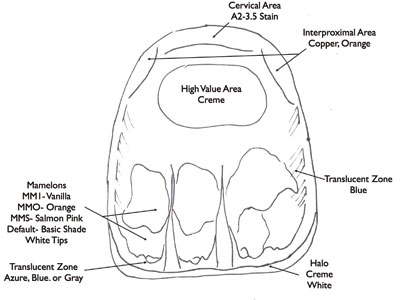 Here is a color map that is typical of what I would draw out for the ceramist when I did a single crown on a front tooth. In the written instructions, I would specify a basic shade. Let’s assume that is A2 for this tooth. Then, besides the basic shade guide, I had a set of tint tabs with various tints of pink, yellow, blue, etc. I would then draw areas where the ceramist would need to add any of those tints to get an exact match with the natural tooth. And then, like I said, after the crown came back from the ceramist I would do an initial try-in, see what the color discrepancies were, and write about those. Later, with the convenience of digital photographs, I would just snap a photo of the try-in and the ceramist could then see where the color needed to be adjusted to get a perfect match. I wouldn’t even THINK of cementing the crown until we had a successful try-in, which is one of the things that really bugs me about your dentist—that she would cement a crown when you didn’t like the color. In fact, my appointments for front tooth crowns were always scheduled as a try-in, and not until we had a successful try-in would we actually cement it.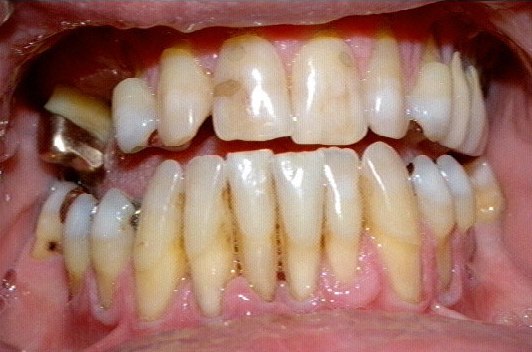
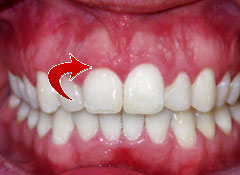
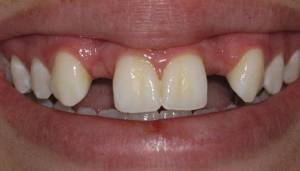
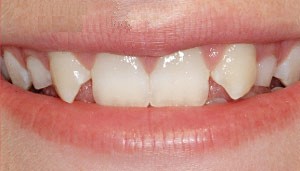 Shaving the canines and even bonding to them or doing porcelain veneers would not look normal. Yes, it looks better than missing teeth, but as a cosmetic dentist, if a patient comes to me looking like this and wants the ideal solution, I would have them put in braces to move the canines back to their normal position and then use one of several methods to replace the lateral incisors.
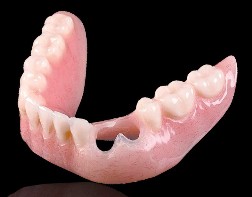
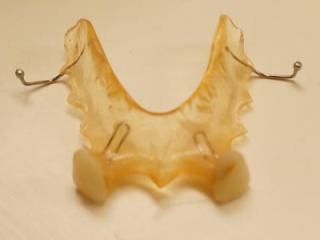 teeth attached. It fits up on the palate and there are two wire clips, one on each side, that snap over the back teeth to hold it in. The cost should be pretty reasonable – maybe a couple hundred dollars, more or less. Here’s a photo of what that appliance would look like.